Guide
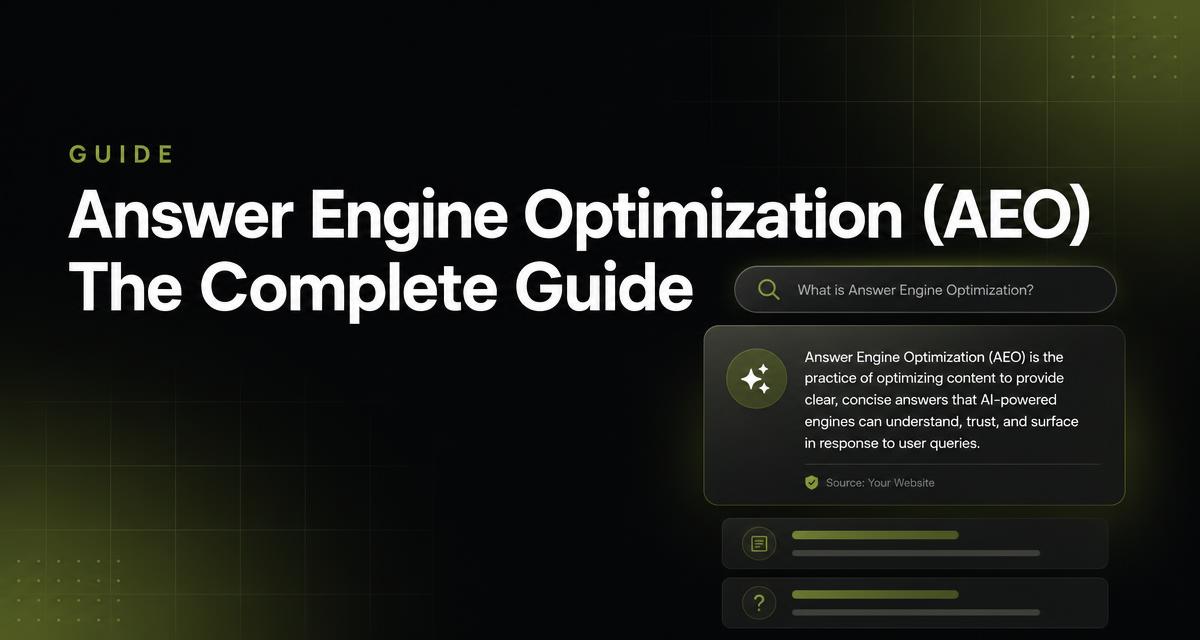
Answer Engine Optimization (AEO): the complete guide
What answer engine optimization is, how AEO differs from SEO and GEO, and a practical playbook for winning featured snippets, voice answers and AI assistant responses.
Published
What answer engine optimization actually means
Answer engine optimization is the practice of writing and structuring content so a machine can extract one clean, correct answer from it and show that answer directly to a person. The answer engine may be Google's featured snippet, a People Also Ask panel, a voice assistant reading a result aloud, or an AI assistant summarizing a question in a chat window.
The core difference from traditional search optimization is what wins. In classic SEO, the unit of success is the ranked URL. In AEO, the unit of success is the passage: a short, self-contained block of text that answers exactly one question without needing the paragraph above it for context.
That distinction changes how you write. A page that argues its way toward a conclusion across 900 words gives an answer engine nothing to lift. A page that states the conclusion in its first two sentences and then explains it gives an answer engine something to quote on every section.
AEO vs SEO vs GEO
SEO optimizes for a position in a list of links. The searcher still clicks, still lands on your page, and your title and description do the persuading. Rankings, crawl health, internal linking and backlinks dominate.
AEO optimizes for the extracted answer. The searcher may never see a list at all — they see one response, attributed to one source. Question-shaped headings, concise answers, tables, definition lists, step lists and FAQ or HowTo structured data dominate.
GEO optimizes for citation inside a generated answer. Here an assistant retrieves several sources, synthesizes them, and names a few. Citable passages, factual specificity, freshness and a consistent brand entity dominate.
The three are layered, not competing. Crawlable, trustworthy pages are the base. AEO formatting makes each section individually extractable. GEO signals decide whether an AI model treats your extracted passage as worth citing. Optimizing for answers almost always improves the other two, because clarity and structure help every system that reads your page.
How answer engines choose a passage
Extraction runs after retrieval. The engine identifies candidate pages for the query, then scans each page for a block that matches the question's shape: a definition query wants a definition sentence, a 'how to' query wants an ordered list, a comparison query wants a table or a parallel pair of statements, a 'how much' query wants a number with units.
Three properties decide which block wins. It must restate the subject explicitly rather than leaning on a pronoun, it must answer within roughly the first 40-60 words, and its format must match the question type. A perfect answer written as a bulleted list rarely wins a definition query, and a beautifully written paragraph rarely wins a procedural one.
This is why AEO work is usually reformatting rather than rewriting. The correct information is already on most pages; it is buried in the middle of a section, phrased as 'this approach means…', and formatted as prose when the query wanted steps.
The page structure that wins answers
Use one question per H2 or H3, written the way a person would type or say it. 'What is answer engine optimization?' beats 'Definitions and background'.
Answer immediately underneath, in a single self-contained paragraph of roughly 40-60 words that names the subject in the first clause. Then expand with context, caveats and examples below the answer, never above it.
Match the format to the intent: numbered lists for procedures, tables for comparisons and specifications, definition sentences for 'what is' questions, and a bolded figure with its unit and date for quantitative questions.
Keep one page focused on one topic cluster. Pages that try to answer twelve unrelated questions compete with themselves and dilute the topical signal that got them retrieved in the first place.
- One question per heading, phrased in natural language
- Direct answer in the first 40-60 words of the section
- Name the subject explicitly — never open with 'It' or 'This'
- Include one concrete number, date, definition or step list
- Match format to question type: list, table, definition or figure
Structured data that supports extraction
Structured data does not force an answer to be shown, but it removes ambiguity about what each block of your page is. FAQPage markup on a genuine question-and-answer section, HowTo markup on real procedures, and Organization markup describing your brand all state facts in a form a parser cannot misread.
Two rules keep this safe. Only mark up content that is visible on the page, and only use the type that genuinely describes the content. Marking a product page as an FAQ, or adding HowTo to a page with no steps, tends to lose eligibility rather than gain it.
Keep the markup and the visible copy in sync. When you update an answer, update the corresponding structured data in the same change — drift between the two is a common reason rich results quietly stop appearing.
Voice search and AI assistants
Voice results are read aloud, so they favour answers that survive being spoken: short sentences, no parenthetical asides, no 'as shown in the table below', and no acronym that has not been expanded once.
Spoken queries also run longer and more conversational than typed ones. Covering the full natural-language question in your heading — including the 'how', 'why' or 'can I' framing — matches those queries far better than a keyword-stuffed fragment.
AI assistants apply the same extraction instinct with a wider net: they read several pages, then paraphrase. Pages already formatted for snippet extraction are the easiest for them to paraphrase accurately, which is why AEO work usually lifts AI visibility as a side effect.
How to measure AEO progress
Search Console is the primary instrument. Filter to queries containing question words, then watch for pages whose average position sits near the top while clicks stay flat — that pattern often means you are being shown as an answer rather than clicked as a link.
Track four things over time: the number of question queries where you appear in the top three positions, how many of your pages hold an extracted answer, the click-through rate on those queries, and whether competitors displace you after they refresh a page.
Re-check quarterly. Extracted answers rotate more often than rankings do, so a page that won a snippet in March can quietly lose it in June without any ranking change at all.
A 30-day AEO playbook
Week 1 — inventory. Export Search Console queries containing 'what', 'how', 'why', 'best' and 'vs'. List every page ranking in positions 2-10 for those queries. These are your fastest wins because relevance is already proven.
Week 2 — reformat. Take the ten highest-impression pages from that list. Convert each relevant section into a question heading followed by a 40-60 word direct answer, and convert procedures into numbered lists and comparisons into tables.
Week 3 — mark up and expand. Add FAQPage or HowTo structured data where the content genuinely matches, expand acronyms inline, and add one specific figure or dated example per section.
Week 4 — measure and roll out. Compare position and impression data against your week 1 baseline, note which formats won, and apply the same pattern to the next tier of pages.
Common AEO mistakes
Burying the answer. The most frequent failure is a section that spends three sentences setting up context before answering. Answer first, contextualize second.
Answering with pronouns. 'It works by comparing the two datasets' cannot be extracted, because the extracted block would not say what 'it' is. Repeat the subject in each answer, even when it reads slightly redundant in the flow of the page.
Marking up content that is not on the page, or using a schema type that does not describe the content. Both risk losing rich-result eligibility entirely.
Publishing a new URL for every refresh. Answer engines reward the page that has held the answer and stayed current; splitting that history across URLs resets it.
Frequently asked questions
- What is answer engine optimization (AEO)?
- Answer engine optimization is the practice of structuring content so search and assistant systems can lift a single, direct answer from your page and present it to the user — as a featured snippet, a People Also Ask entry, a voice response or a line inside an AI assistant's reply.
- How is AEO different from SEO?
- SEO optimizes for position in a ranked list of links, so the click is the goal. AEO optimizes for being the answer itself, so the extraction is the goal. AEO depends on the same crawlability and quality foundations as SEO, then adds question-shaped headings, concise direct answers, definition and step formatting, and structured data such as FAQPage and HowTo.
- How is AEO different from GEO?
- AEO targets a single extracted answer from one page — a snippet, a PAA box, a voice result. GEO (generative engine optimization) targets being one of several sources an AI model retrieves and cites while synthesizing a longer generated answer. AEO formatting is the foundation; GEO adds entity consistency, freshness and citation-worthy passages.
- Which pages should I optimize for answer engines first?
- Start with pages that already rank in positions 2-10 for question queries in Search Console. They have proven relevance, so a formatting change — adding a question H2 and a 40-60 word direct answer — is usually enough to become the extracted answer.
- Does AEO reduce my traffic because users get the answer without clicking?
- Some answers are resolved on the results page, so measure impressions and brand visibility alongside clicks. In practice, being the cited answer for the definition-level question is what qualifies you for the follow-up commercial query, where the click still happens.
Where to go next
Once your pages are formatted for extraction, the next layer is generative search: being cited inside AI answers rather than only lifted as a snippet. Read the Generative Engine Optimization guide for the citation, freshness and entity work that builds on this foundation.
See your AEO score
CrawlWeb scores AEO alongside SEO, GEO and AI Search Visibility, then turns the gaps into a prioritized action plan.
Run a free analysis