Tool Comparison
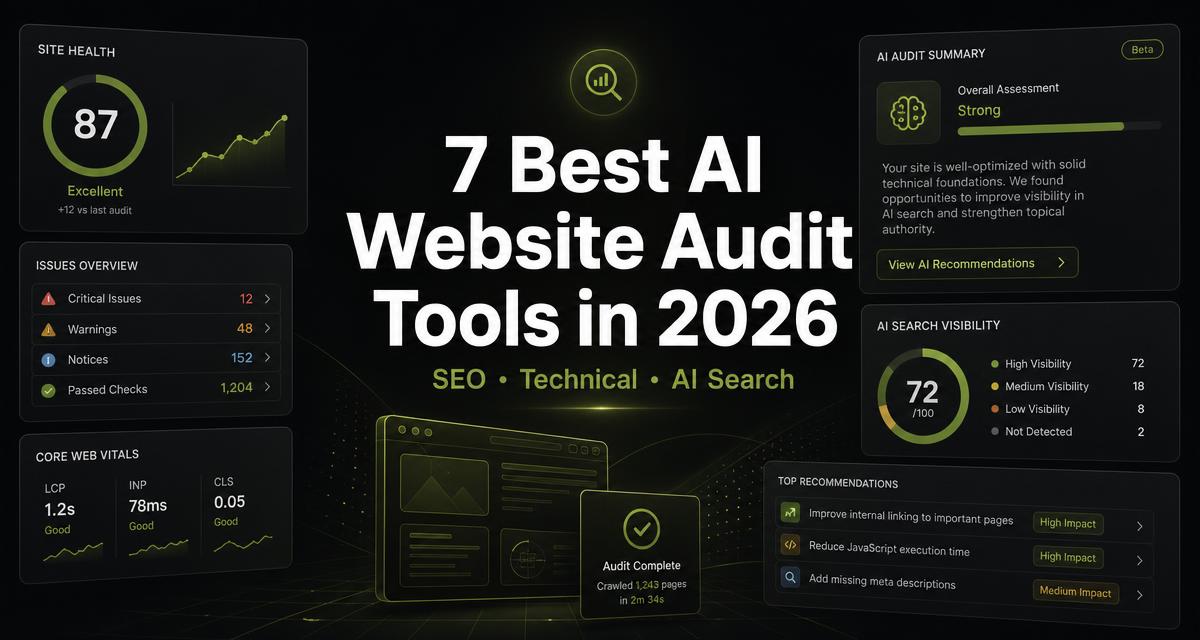
7 Best AI Website Audit Tools in 2026: Find SEO, Technical and AI Search Issues
11 min read
Published
Quick answer
The best AI website audit tool depends on what you need. Some tools are better for deep technical crawling, others focus on content optimization, website performance, or search visibility. CrawlWeb suits people who want a simpler starting point — analyze a website, identify SEO and technical issues, and turn the findings into clear next steps. Other popular options include Semrush, Ahrefs, Screaming Frog, SE Ranking, Surfer, and Google Search Console.
Key takeaways
- The hard part of a website audit is not collecting data — it is knowing what is wrong, what matters most, and what to fix first.
- AI website audit tools turn technical findings into prioritized, plain-language recommendations.
- CrawlWeb is built around one question: what should I fix next?
- Semrush and Ahrefs suit larger SEO workflows; Screaming Frog suits deep technical crawls.
- Surfer covers content optimization only, and Google Search Console gives data rather than direction.
- A useful audit covers technical SEO, on-page SEO, internal linking, structured data, content quality, and AI search visibility.
Why website audits are hard
Your website may have hundreds of pages, technical issues, missing SEO opportunities, and content problems. The difficult part is not finding data. The difficult part is knowing what is actually wrong, which problems matter most, what you should fix first, and how those fixes could improve your visibility.
Traditional website audit tools can generate long lists of warnings. AI website audit tools aim to make that process easier by analyzing website data and turning it into prioritized recommendations. In this guide, we compare some of the best AI website audit tools in 2026 and explain what to look for when choosing one.
- What is actually wrong?
- Which problems matter most?
- What should you fix first?
- How could those fixes improve your visibility?
Quick answer: what is the best AI website audit tool?
The best AI website audit tool depends on what you need. Some tools are better for deep technical crawling. Others focus on content optimization, website performance, or search visibility.
CrawlWeb is designed for people who want a simpler starting point: analyze a website, identify SEO and website issues, and turn the findings into clear next steps.
The right choice depends on whether you need an easy-to-understand website audit, a deep technical crawl, keyword research, backlink analysis, or a combination of multiple tools.
- CrawlWeb
- Semrush
- Ahrefs
- Screaming Frog
- SE Ranking
- Surfer
- Google Search Console
What is an AI website audit tool?
An AI website audit tool analyzes a website and helps identify issues or opportunities that could affect its performance. Depending on the platform, an audit may examine SEO elements, page titles and meta descriptions, heading structure, internal linking, broken links, indexing signals, structured data, website performance, mobile usability, content quality, search visibility, and AI search readiness.
AI can help turn technical findings into explanations and recommendations that are easier to understand. Instead of simply showing “Missing meta description on 14 pages”, an AI-powered system may explain: these pages are missing descriptions that help search engines understand their content, so start with your highest-value pages first.
That difference can be important for small businesses, marketers, founders, and website owners who do not want to manually interpret hundreds of technical warnings.
- SEO elements, titles and meta descriptions
- Heading structure and internal linking
- Broken links and indexing signals
- Structured data and website performance
- Mobile usability and content quality
- Search visibility and AI search readiness
1. CrawlWeb — best for turning website analysis into clear next steps
CrawlWeb is an AI-powered website growth platform designed to help users understand what may be holding their website back. The goal is not simply to generate another long list of warnings.
Instead, CrawlWeb focuses on helping users move from website data to problems, from problems to priorities, and from priorities to actions. A website audit can involve multiple areas of a website, including SEO and search visibility, and the platform is particularly useful for users who want a clearer understanding of what to work on next.
CrawlWeb is designed around a simple question: what should I fix next? That matters because many website owners already have access to data from tools such as Google Search Console and analytics platforms. What they often need is help understanding the information and deciding where to focus. Explore the full CrawlWeb feature set or compare plans and pricing.
- Best for: SaaS founders and small businesses
- Best for: website owners and marketers
- Best for: SEO beginners
- Best for: teams looking for a simpler website audit workflow
2. Semrush — best all-in-one SEO platform
Semrush is one of the largest SEO platforms available. It combines keyword research, site audits, backlink analysis, rank tracking, competitor research, and content tools in one place.
For businesses and agencies that want many SEO tools in one platform, Semrush can be a strong option. The main challenge for smaller teams is that an all-in-one platform can feel overwhelming when you only need to understand what is wrong with your website.
Limitation: you may need time and SEO knowledge to understand and prioritize the large amount of data available.
- Best for: SEO professionals and agencies
- Best for: marketing teams
- Best for: businesses with larger SEO workflows
3. Ahrefs — best for backlinks and competitor research
Ahrefs is widely used for backlink research, keyword analysis, and competitor research. It can help answer questions such as who links to my competitors, which pages receive the most backlinks, which keywords competitors rank for, and what content opportunities exist.
Ahrefs also provides website auditing capabilities. For businesses that want strong backlink and competitive research alongside SEO data, it can be a valuable part of an SEO stack.
Limitation: the amount of data can be more than a small website owner needs for a simple website audit.
- Best for: backlink research
- Best for: competitor analysis
- Best for: keyword research
- Best for: SEO professionals
4. Screaming Frog — best for deep technical website crawling
Screaming Frog SEO Spider is a powerful technical crawler. It can help identify issues involving broken links, redirects, missing titles, duplicate metadata, indexing directives, canonical tags, internal links, and structured data.
It is particularly useful when you need detailed technical information about how a website is structured.
Limitation: the interface and output can be intimidating for beginners. Users often need to interpret the findings themselves before deciding what to fix.
- Best for: technical SEO professionals
- Best for: developers
- Best for: large websites
- Best for: detailed site audits
5. SE Ranking — best for an affordable all-in-one SEO workflow
SE Ranking combines several common SEO features into one platform. Depending on the plan, users can access tools for rank tracking, keyword research, website audits, competitor research, and backlinks.
It can be a useful option for freelancers and small agencies that want multiple SEO tools without building a separate stack.
Limitation: like other all-in-one platforms, users may still need to decide which audit findings deserve attention first.
- Best for: freelancers
- Best for: small agencies
- Best for: businesses managing multiple SEO activities
6. Surfer — best for content optimization
Surfer focuses primarily on content optimization. It helps users analyze content and identify opportunities related to topics, keywords, and on-page optimization, which makes it useful for teams creating or improving articles designed to compete in search results.
However, content optimization is only one part of website health. A website can have well-optimized articles while still having problems with technical SEO, internal linking, indexing, structured data, or website architecture.
Limitation: it is not a replacement for a full website audit.
- Best for: content teams
- Best for: SEO writers
- Best for: content marketers
7. Google Search Console — best free starting point
Google Search Console is an essential free tool for understanding how a website performs in Google Search. It provides information about search queries, clicks, impressions, indexed pages, crawling and indexing issues, and Core Web Vitals. Every website owner should consider setting it up.
However, Search Console mainly provides data. It does not always tell you exactly what to do next. You may see declining impressions, pages that are not indexed, or search queries with low click-through rates — but you still need to investigate why those problems are happening.
This is where website audit and analysis tools can complement Search Console.
- Search queries, clicks and impressions
- Indexed pages
- Crawling and indexing issues
- Core Web Vitals
Comparison: AI website audit tools
Use this table to compare the seven tools side by side before you commit to one platform.
| Tool | Best for | Technical SEO | Keyword research | Backlinks | Beginner friendly |
|---|---|---|---|---|---|
| CrawlWeb | Clear website insights and next steps | Yes | Developing workflow | Developing workflow | High |
| Semrush | All-in-one SEO | Yes | Yes | Yes | Medium |
| Ahrefs | Backlinks and competitor research | Yes | Yes | Yes | Medium |
| Screaming Frog | Technical crawling | Excellent | No | No | Low to medium |
| SE Ranking | Affordable SEO platform | Yes | Yes | Yes | Medium |
| Surfer | Content optimization | Limited | Content-focused | No | High |
| Google Search Console | Free search performance data | Yes | Search data | No | Medium |
What should an AI website audit check?
A useful website audit should look beyond a single SEO score. These six areas cover the checks that matter most. Related reading: SEO vs AEO vs GEO and how to optimize your website for AI search.
1. Technical SEO
Technical problems can prevent search engines from properly crawling or understanding your website. An audit should look for issues involving broken pages, redirect problems, robots directives, canonical tags, sitemap issues, indexing signals, and duplicate pages.
2. On-page SEO
Each important page should clearly communicate what it is about. This includes page titles, meta descriptions, H1 headings, heading structure, content relevance, and image alt text.
3. Internal linking
Internal links help users and search engines discover related content. For example, a guide about AI SEO could naturally link to an AI SEO tools comparison, a technical SEO guide, a website audit guide, or a related product page. Good internal linking creates stronger connections between related pages.
4. Structured data
Structured data can help search engines better understand your content. Depending on the page, this may include Article schema, FAQ schema, Organization schema, SoftwareApplication schema, and Breadcrumb schema. The important thing is to use the appropriate structured data for the content rather than adding unnecessary markup everywhere.
5. Content quality
An audit should also consider whether important pages provide enough useful information. Thin pages, outdated content, and unclear page topics can limit search visibility.
6. AI search visibility
Search is changing. People increasingly use AI-powered search experiences to ask questions and discover products. Websites should therefore think beyond traditional keyword rankings and consider whether their content is clear, well structured, easy to understand, properly linked, and accessible to crawlers.
How to choose the right AI website audit tool
Five questions make the shortlist much easier to narrow down. If you are weighing a specific incumbent, read best Ahrefs alternatives for website audits in 2026.
1. Do I need data or recommendations?
Some tools provide enormous amounts of data. Others focus more on helping you understand what that data means. If you already feel overwhelmed by SEO reports, prioritize a tool that helps with recommendations and prioritization.
2. How technical is my website?
A large ecommerce website may need a powerful crawler. A small SaaS website may benefit more from clear recommendations about content, internal linking, SEO basics, and search visibility.
3. Do I need backlinks and keywords?
If backlink analysis and keyword research are central to your strategy, a platform such as Ahrefs or Semrush may be useful. If your immediate problem is understanding your own website, start with an audit.
4. Can I understand the results?
The best audit is not necessarily the one with the most warnings. A useful audit should help you answer: what is the issue, why does it matter, and what should I do next?
5. Will I actually use the tool?
A complicated platform with hundreds of unused features may not be better than a focused tool that helps you take action every week.
Why AI website audits are becoming more useful
Traditional website auditing is excellent at detecting technical problems. The next challenge is interpretation. Website owners do not just need another report containing 200 warnings.
They need help deciding what should be fixed first, which pages matter most, which issues are affecting visibility, what can be improved quickly, and what should be monitored over time.
AI can help bridge the gap between raw website data and practical action. That does not mean AI should blindly make changes to a website — human review is still important — but AI can make the analysis process faster and easier to understand.
- What should be fixed first?
- Which pages matter most?
- Which issues are affecting visibility?
- What can be improved quickly?
- What should be monitored over time?
Start with your own website
Before spending months researching competitors, building backlinks, or publishing dozens of articles, it can be useful to understand the current state of your own website. Then prioritize the improvements that are most relevant to your website.
- Homepage
- Important product or service pages
- Blog content
- Internal links
- Titles and descriptions
- Structured data
- Sitemap
- Indexing signals
Audit your website with CrawlWeb
CrawlWeb is built to help website owners move beyond a list of technical warnings and toward a clearer understanding of what to improve. Analyze your website, review the findings, and focus on the next actions that can help strengthen your site's SEO and search visibility.
Start your CrawlWeb audit today.
Action checklist
- Decide whether you need more data or better prioritization before choosing a tool.
- Run a full audit of your homepage and highest-value pages first.
- Fix crawling and indexing blockers before cosmetic on-page issues.
- Review titles, meta descriptions and heading structure on money pages.
- Add structured data that matches each page type — nothing more.
- Strengthen internal links between related guides and product pages.
- Check that your content is clear and quotable for AI search experiences.
- Re-audit after each release so new issues are caught early.
Frequently asked questions
What is the best AI website audit tool in 2026?
There is no single best tool for everyone. CrawlWeb suits owners who want prioritized next steps, Semrush and Ahrefs suit larger SEO workflows, Screaming Frog suits deep technical crawls, and Google Search Console is the best free starting point.
Are AI website audit tools better than traditional crawlers?
They solve different problems. Traditional crawlers are excellent at detecting technical issues; AI tools help interpret those findings, explain why each issue matters, and suggest what to fix first.
Is Google Search Console enough on its own?
Search Console is essential, but it mainly reports data such as impressions, clicks and indexing status. It rarely tells you why a problem happened or what to change, so most owners pair it with an audit tool.
What should a website audit include?
Technical SEO, on-page SEO, internal linking, structured data, content quality, and AI search visibility. Anything less leaves part of your website's performance unexamined.
Can AI fix website issues automatically?
AI can prepare and preview many fixes, but human review remains important. Treat AI output as a prioritized recommendation, then approve changes before they go live.
How often should I audit my website?
Audit after every significant release, and at minimum monthly. Deployments frequently introduce new crawling, indexing and metadata problems that only a fresh audit will surface.
Ready to grow your website with AI?
Run a free AI website audit and see your SEO, AEO and GEO scores in minutes.
Start free